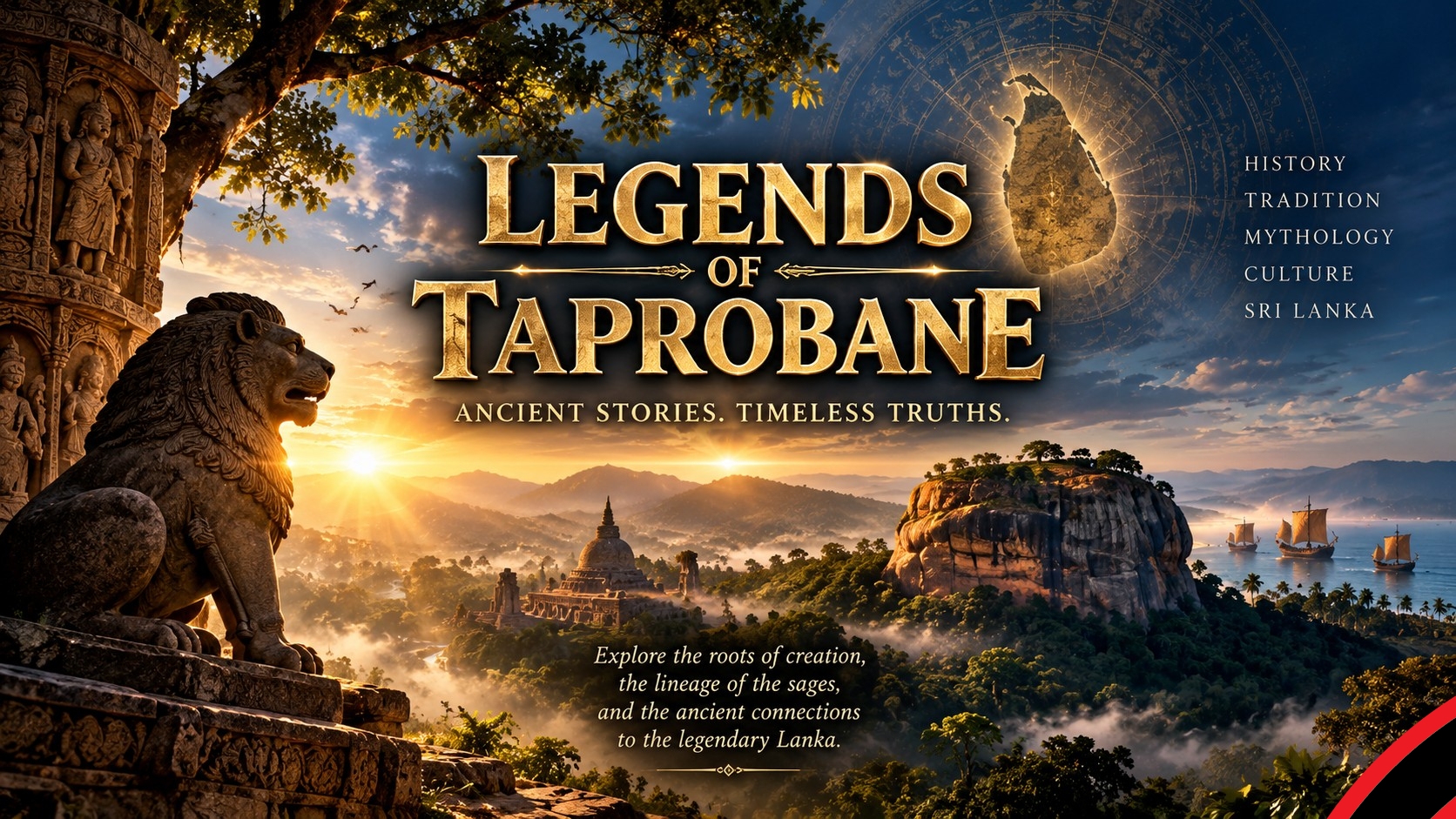
BEFORE SRI LANKA WAS CALLED SRI LANKA…
When we look at Sri Lanka today, we see a beautiful island in the Indian Ocean. But thousands of years ago, this island was already known beyond its shores.
Ancient writers used names such as Taprobane, while Indian and Sri Lankan traditions preserved names such as Lanka and Tambapanni.
But what was this island like before the great kingdoms described in later chronicles?
And, perhaps more importantly…
WHO WERE THE PEOPLE OF ANCIENT LANKA?
This question takes us into a fascinating world where history, archaeology, oral traditions and mythology meet.
Ancient Sri Lankan traditions speak about several groups, including the Yakkhas, Nagas and Devas. The Mahavamsa and other chronicles preserve stories about kings, migrations, battles and religious traditions. Indian literature contains its own traditions concerning Lanka. Meanwhile, archaeological discoveries provide evidence about settlements, technology, agriculture, trade and human activity.
These sources do not always tell exactly the same story.
And that is what makes the investigation interesting.
🐍 Who were the Nagas?
Were “Naga” references describing a particular community, a cultural tradition, a political group, or something remembered through later mythology?
🔥 Who were the Yakkhas?
Were they remembered as supernatural beings, ancient inhabitants, or a combination of historical memory and mythology?
✨ And what about the Devas?
Were these descriptions religious concepts, legendary ancestors, powerful communities, or stories transformed through generations?
We should not immediately assume that every legendary character was a historical person.
But we should also ask:
Why were these stories preserved for so long?
Ancient societies did not leave us with modern photographs, databases or newspapers. Much of their knowledge survived through stories, inscriptions, religious traditions, monuments, place names and archaeological remains.
Sometimes a legend may contain a historical memory.
Sometimes mythology may explain something that people could no longer understand.
And sometimes a story may simply be a story.
Our challenge is to examine the evidence and separate what is documented, what is traditionally believed, and what remains uncertain.
🌊 There is another fascinating part of this story.
Sri Lanka's position in the Indian Ocean placed it close to ancient maritime routes connecting South Asia, Southeast Asia, the Middle East and the wider ancient world.
So when we hear stories about ancient kings, merchants, warriors, Nagas, Yakkhas and distant lands, we should also ask:
Could ancient Lanka have been far more connected to the world than we imagine?
This is where our journey begins.
📜 We will explore chronicles.
🏺 We will examine archaeology.
🌊 We will follow ancient trade routes.
🐍 We will investigate Naga traditions.
🔥 We will explore Yakkha traditions.
✨ We will compare Deva traditions.
👑 We will trace legendary genealogies.
🌏 And we will compare Sri Lankan traditions with Indian, Buddhist and other ancient sources.
But we won't tell you what you must believe.
We want you to investigate with us.
❤️ Let's explore this together.
🤔 YOUR TURN
What do you think?
Was ancient Lanka simply an isolated island — or was it part of a much larger ancient world?
And when we hear the names Naga, Yakkha and Deva, what do you think they originally represented?
👇 Share your interpretation.
Maybe your question will become the beginning of our next discovery.
📚 Sources we will explore throughout this series:
Mahavamsa • Dipavamsa • Ramayana traditions • Pali and Sanskrit literature • Archaeological research • Ancient geographical writings • Epigraphic evidence • Historical research on Indian Ocean trade
🌿 LEGENDS OF TAPROBANE
Where History Meets Legend.
🇱🇰 English | සිංහල | தமிழ்
#legendsoftaprobane #ancientsrilanka #taprobane #lanka #tambapanni #srilankanhistory #ancienthistory #naga #yakkha #deva #archaeology #indianoceanhistory #historyandlegend